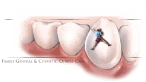


It twinges when you drink something cold, or when you bite down a certain way. Then it settles, a few days go by, and you stop thinking about it. Most people in that spot decide the tooth has sorted itself out. Teeth do not heal the way a cut on your hand does, though. When tooth pain fades, it usually means the cause has gone quiet for now, not that it has gone away.
This is a plain guide to what on-and-off tooth pain tends to mean, what you can do at home, and when it is worth calling our office in Holladay.
Why tooth pain comes and goes
A tooth has a hard outer shell and a soft center that holds the nerve. Pain starts when something gets close enough to that nerve to irritate it. Early on, the irritation only shows up with a trigger such as cold, sugar or pressure, which is why the ache seems to switch on and off. The most common causes are:
- A cavity. Decay works its way inward slowly. In the early stage it may only bother you with sweets or cold drinks.
- A cracked tooth or a worn filling. These tend to hurt when you bite down or let go, and feel fine the rest of the time.
- Receding gums. When the gum pulls back, part of the root is exposed, and the root is far more sensitive than enamel.
- Clenching or grinding. Teeth that are sore in the morning and better by lunch are often being worked hard overnight.
These can feel alike from the inside. An exam, and sometimes an X-ray, is what tells them apart.
What the type of pain can tell you
- A quick zing that fades in seconds. Often an early problem such as a small cavity, worn enamel or an exposed root. This is usually the simplest stage to treat.
- Sharp pain when you bite. This points toward a crack or a filling that is starting to fail.
- An ache that lingers after hot or cold, throbs on its own, or wakes you at night. The nerve inside the tooth is likely inflamed. This kind of pain rarely settles without treatment.
- Severe pain that suddenly stops. This can mean the nerve has died. An infection can still be present, with no pain left to warn you about it.
What waiting usually costs
None of this happens overnight, and it is not meant to alarm you. The point is that the same tooth has a simple fix early on and a more involved one later, and the main thing separating the two is time.
- A small cavity is usually repaired with a dental filling in a single visit.
- A larger area of damage may need a dental onlay or a dental crown to rebuild the tooth.
- Once decay or a crack reaches the nerve, the tooth usually needs a root canal. Despite its reputation, that is the treatment that ends the pain and keeps the tooth.
- If the tooth cannot be saved, the remaining option is a tooth extraction, followed by a conversation about replacing it.
Each step takes more time in the chair and costs more than the one before it. A tooth that only hurts now and then is often still near the top of that list.
When to call us the same day
Some signs should not wait for a convenient week. Call 801-274-3889 right away if you have:
- Swelling in your gum, face or jaw
- A fever along with tooth pain
- A small bump on the gum near the tooth, or a bad taste that keeps coming back
- Pain that keeps you awake or does not ease with an over-the-counter pain reliever
- A tooth that has broken or been knocked loose
We offer emergency dental care in Holladay. Call ahead, and we will get you in as soon as we can and tell you what to do in the meantime. If you have swelling together with trouble swallowing or breathing, go to the nearest emergency room.
What you can do at home in the meantime
- Rinse gently with warm salt water.
- Take an over-the-counter pain reliever as directed on the label. Do not hold aspirin against the gum, because it can burn the tissue.
- Chew on the other side, and avoid very hot, very cold and sugary food and drink.
- Keep brushing and flossing around the tooth, gently.
These ease the symptoms. They do not treat what is causing them.
What happens when you come in
Dr. David S. Cannon has practiced in Holladay since 2002. A visit for a sore tooth starts with a look at the tooth and, if it is needed, an X-ray. He explains what he sees and what your options are before anything is done, and there is no lecture if it has been a while since your last cleaning and exam. Everyone on our team speaks Spanish.
If cost is part of the reason you have been waiting, we accept a number of insurance plans, offer CareCredit, and have an in-office membership plan for patients without insurance. The details are on our financial options page.
Our office is at 1434 East 4500 South, Suite #202, in Holladay, a short drive for our Millcreek patients as well.
Common questions
Can a toothache go away on its own?
The pain can. The cause usually does not. Sensitivity after a recent filling or whitening often settles within a couple of weeks. Pain from decay, a crack or an infection does not resolve by itself, even when it goes quiet for a while.
Is it an emergency if it only hurts sometimes?
Usually not. It is still worth an appointment in the next week or two instead of someday, because this is the stage where the fix tends to be smallest.
How long is too long to wait?
If the pain has come back more than once, or has lasted longer than a day or two, book a visit. If any of the same-day signs above appear, call right away.
It has been years since I saw a dentist. Is that a problem?
No. Many of our patients come back after a long gap. You will be told what is going on and what your choices are, without judgment.
If a tooth has been bothering you on and off, call Pinnacle Dental at 801-274-3889 or request an appointment online.