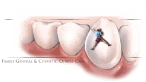


Most fillings do their job quietly for years. Because an old filling does not usually hurt when it starts to wear out, it is easy to assume it is fine just because it has always been there. Fillings are not permanent, though. Chewing, clenching, temperature changes and time all wear on them, and the tooth around them can change too.
This is a plain guide to the signs that an old filling may be failing, and what the options are when it needs more than a simple replacement.
Signs your old filling may be failing
- A dark line or shadow around the edge. This can be staining, but it can also mean the seal is breaking down and decay has started underneath.
- New sensitivity. A tooth that was fine for years and now reacts to cold, sweets or biting may have a gap at the edge of the filling.
- A rough or sharp edge. If your tongue keeps catching on it, part of the filling or the tooth may have chipped.
- A crack you can see or feel. Lines in the filling, or in the tooth around it, are worth having checked.
- Food catching in the same spot. The filling may have worn down, or the contact with the next tooth may have opened.
- Pain when you bite down or let go. This can point to a crack in the tooth itself.
Some failing fillings cause no symptoms at all. That is one reason a routine exam, and sometimes an X-ray, matters even when nothing hurts.
Why old fillings fail
A filling has to stand up to years of biting and chewing. Over time the material can wear, chip or pull away slightly from the tooth at the edges. Clenching or grinding can speed this up. Once the seal at the edge opens, bacteria can get underneath and start new decay, often out of sight. A large filling can also leave the remaining walls of the tooth thin, and thin walls are more likely to crack.
What waiting can cost
This is rarely an emergency, and it is not meant to worry you. It is a matter of timing. A worn filling caught early can often be replaced with a new filling. Left longer, decay underneath or a crack in a weakened wall can mean the tooth needs an onlay or a crown instead. If decay reaches the nerve, the tooth may need a root canal, and a tooth that cracks badly enough may not be possible to save.
Each of those steps takes more time in the chair than the one before it. The earlier stage is usually the simpler one.
Filling, onlay or crown: what is the difference?
A new filling
If the damage is small and plenty of healthy tooth remains, the old filling can usually be removed and replaced with a new dental filling in a single visit.
An onlay
A dental onlay, sometimes called a partial crown, is used when the damage is too extensive for a filling but not extensive enough for a full crown, particularly when it reaches one or more of the cusps, the raised points on the chewing surface. Onlays are custom-made from porcelain, composite resin or gold, and they conserve much of your natural tooth.
A crown
A dental crown fits over the entire tooth, starting at the gumline. It may be recommended when a tooth is too damaged or decayed for a filling to work, when a tooth is fractured or weak, or when a large filling leaves little natural tooth behind. Crowns can be made of porcelain, gold or porcelain fused to metal.
Which option fits depends on how much healthy tooth is left, where the damage is and how your bite comes together. Dr. David S. Cannon explains what he sees and what your options are before anything is done.
What happens at your visit
We look at the filling and the tooth around it, check your bite and take an X-ray if one is needed. You will hear plainly what we find. If the filling is still sound, we will tell you that too.
If cost is part of the decision, we accept a number of insurance plans, offer CareCredit, and have an in-office membership plan for patients without insurance. The details are on our financial options page. Everyone on our team speaks Spanish.
Our office is at 1434 East 4500 South, Suite #202, in Holladay, a short drive for our Millcreek patients as well.
Common questions
How long do fillings last?
It varies with the size of the filling, the material, where it sits in your mouth and whether you clench or grind. There is no set expiration date, which is why regular checks matter.
Can a failing filling be replaced with another filling?
Often, yes, if enough healthy tooth remains. When a lot of the tooth is gone or a cusp is damaged, an onlay or a crown may be the stronger choice.
Does a failing filling always hurt?
No. Many cause no pain until the problem is larger. A dark edge, a rough spot or food catching in one place is worth mentioning even if nothing hurts.
If an old filling has been bothering you, or you are not sure how it is holding up, call Pinnacle Dental at 801-274-3889 or request an appointment online.